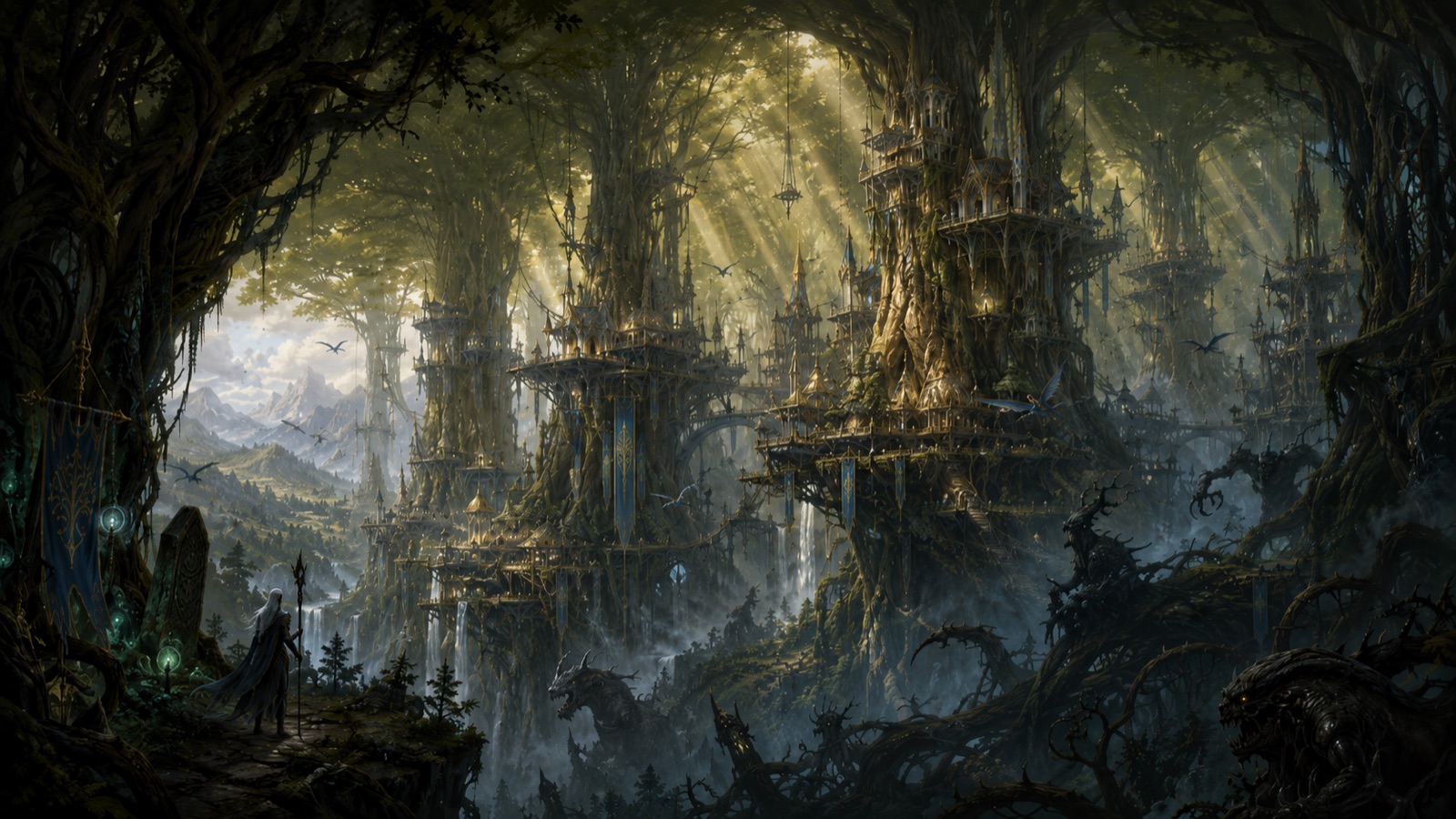
The Great Hunter
The Great Hunter is a homebrew Warlock patron available at this table —
an Otherworldly Patron whose warlocks become supernatural hunters. Its
identity is melee cantrip damage, self-healing, and pursuit. Where
most warlocks reach for a spell, a Warlock of the Great Hunter closes
the distance: a manifested weapon in hand, drinking vitality out of
whatever they have run down. The patron sheet
(sources/great-hunter-warlock_subclass.md) is the source for this
page.
The patron has no fixed form. The sheet offers an ancient dragon, a deathless predator, a forgotten god of the hunt, a celestial beast, a parasitic intelligence, a great lion stalking among the stars, an immortal that feeds on other immortals — or no creature at all, but a principle woven into creation: that nothing grows so powerful it can never again become prey. Everything is prey to something. Which of these it is, and what it expects to be hunted, is left to the player and the DM.
The sheet is explicit that the pact carries no alignment. Some hunt monsters, some tyrants, some things that have escaped the boundaries of life and death. “What matters is what you choose as your quarry — and why.”
Progression
Derived from the sheet’s own headings; the sheet has no progression table of its own.
| Warlock level | Features |
|---|---|
| 3 | Great Hunter Spells, Hunter’s Edge, Hunter’s Surge |
| 5 | Expanded spells; Hunter’s Edge to 2d10 |
| 6 | Glide-Step |
| 7 | Expanded spells |
| 9 | Expanded spells |
| 10 | Hunter’s Arsenal |
| 11 | Blood Scent; Hunter’s Edge to 3d10 |
| 14 | Apex Hunter |
| 17 | Hunter’s Edge to 4d10 |
Great Hunter Spells
Always prepared once the level is reached, and they don’t count against prepared-spell limits.
| Warlock level | Spells |
|---|---|
| 3 | Inflict Wounds, Detect Magic, Blur, Locate Object |
| 5 | Nondetection, Haste |
| 7 | Freedom of Movement, Locate Creature |
| 9 | Steel Wind Strike, Passwall |
Level 3
Hunter’s Edge
The subclass’s engine: a bespoke cantrip, granted free and not counted against cantrips known.
- Evocation cantrip. Casting time Action or Bonus Action, range 5 feet, components V, S, instantaneous.
- Melee spell attack against one creature. On a hit, 1d10 damage.
- The damage type is chosen when the cantrip is gained and again on each Long Rest, from acid, cold, fire, lightning, necrotic, poison, radiant, or thunder.
- It can be cast at most twice on the same turn — once as an Action and once as a Bonus Action.
- Damage rises to 2d10 at level 5, 3d10 at 11, and 4d10 at 17.
The manifestation can be a claw, blade, talon, fang, spectral sword, spearhead, shard of shadow, or anything else fitting the pact; the appearance has no mechanical effect.
The sheet states plainly that Hunter’s Edge is a damaging Warlock cantrip and is eligible for Agonizing Blast and anything else that keys off one.
Hunter’s Surge
The predatory state the rest of the subclass hangs off.
- Action to enter, lasts 1 minute.
- Uses equal to Proficiency Bonus, all regained on a Long Rest.
- It doesn’t require Concentration, and while it is up the warlock can’t hold Concentration at all — entering the Surge ends any Concentration already running.
Hunter’s Frenzy. While the Surge is active:
- No spells of level 1 or higher, by any means — Action, Bonus Action, or Reaction.
- The Action on their turn can only be the Attack action or the Magic action.
- If it’s the Magic action, only a Warlock cantrip with a casting time of an Action, and only one that either targets the caster alone or can damage at least one other creature.
- Movement, Bonus Actions, and Reactions are otherwise unrestricted.
Hunter’s Feast. Once on each of their turns during the Surge, when they hit with Hunter’s Edge, they can feed on the hit:
- Predatory damage — the attack deals an extra 1d4 + Charisma modifier, in Hunter’s Edge’s damage type.
- Feast — after all damage from that hit resolves, the Feast amount is half the hit’s total damage, rounded down, plus Proficiency Bonus, and it can’t exceed the target’s Hit Points immediately before the hit.
- They regain that many Hit Points, up to their maximum. Anything left over becomes Temporary Hit Points, capped at their Warlock level.
Only one Hunter’s Edge hit per turn can be fed on, even if the cantrip is cast twice.
Level 6: Glide-Step
The warlock rides a hair above the ground rather than standing on it. Unavailable in Medium or Heavy armor, or while carrying a creature larger than Tiny.
- Move across liquid surfaces as though they were solid ground.
- Nonmagical Difficult Terrain caused solely by the surface — mud, shallow water, ice, loose sand — costs no extra movement.
- No ability check needed purely to keep footing on a narrow, slippery, unstable, or fragile horizontal surface.
- Their weight doesn’t trigger nonmagical weight-activated mechanisms such as pressure plates, and doesn’t break a fragile surface.
- No damage from a fall of 100 feet or less.
The sheet is careful about what this is not: no Fly Speed, and gliding needs a solid or liquid surface directly beneath — move past one and they fall normally until another is under them. It doesn’t stop physical contact with tripwires, snares, caltrops, spikes, or barriers, and it grants no Resistance or Immunity to damage or hazards coming off the surface.
Level 10: Hunter’s Arsenal
Adaptive Resistance. On gaining the feature and on each Long Rest, choose one of acid, cold, fire, lightning, necrotic, poison, radiant, or thunder. They have Resistance to it until the next choice.
Hunter’s Vigil. They can cast Alarm without a spell slot or Material components, once per Short or Long Rest.
Hunter’s Trail. A scent-line to one designated quarry.
Designating Prey. One uninterrupted minute examining a physical trace — blood, hair, fur, scales, feathers, teeth, shed skin, or an object the creature personally wore or carried for at least an hour in the last seven days and that nobody has carried since. They need never have seen or identified the creature. The minute requires Concentration as if on a spell, and the Magic action each turn if turns are being tracked; break it and the attempt fails. One Prey at a time, and no new designation until a Long Rest. The connection lasts until they designate another or the Prey dies.
Reading the trail. Once per Long Rest, one uninterrupted minute of meditation: Speed 0, Concentration as if on a spell, the Magic action each tracked turn, and no Bonus Actions or Reactions. Interrupt it and nothing is learned — but the use isn’t spent. Success gives a single snapshot, visible only to them, of the Prey’s direction and rough distance at that moment, and then it’s gone.
Direction comes only if the Prey is on the same plane and more than 300 feet away; there is no maximum range. Distance is banded:
| Distance to Prey | What they sense |
|---|---|
| 300 feet or less | Somewhere within 300 feet — no direction |
| Up to 1 mile | Within 1 mile |
| Up to 5 miles | Within 5 miles |
| Up to 10 miles | Within 10 miles |
| Up to 25 miles | Within 25 miles |
| Up to 50 miles | Within 50 miles |
| Up to 100 miles | Within 100 miles |
| Beyond that | More than 100 miles away |
The sheet spends a long paragraph on what it withholds, which is most things: no route, no precise location, no elevation, no sense of whether the Prey is moving, its appearance, its surroundings, or what stands between. It can’t see or target the Prey, reveal a Hidden or Invisible creature, pick the Prey out of a crowd, or defeat illusions, disguises, cover, or concealment. It doesn’t say whether the Prey is dead. Off-plane gives nothing, though the connection survives.
Level 11: Blood Scent
An upgrade to the Surge rather than a feature of its own. Once on each of their turns while Hunter’s Surge is active, hitting a creature at half its Hit Points or fewer with Hunter’s Edge deals an extra 1d6 in the same damage type.
Blood Scent’s damage counts toward the hit’s total when working out Hunter’s Feast.
Level 14: Apex Hunter
Hunter’s Veil. While the Surge is active:
- Large or larger creatures have Disadvantage on attack rolls against them.
- Any creature maintaining Concentration has Disadvantage on attack rolls against them.
- They can move through another creature’s space, which is Difficult Terrain for them and can’t be where they end their turn.
Stacking sources of Disadvantage don’t compound on one roll.
Hunter’s Renewal. When casting a Warlock cantrip that can deal damage, they can name one creature the casting targets or catches in its area — before any attack roll, saving throw, or damage roll. Once the casting resolves, if that creature took damage, they regain Hit Points equal to the total that casting dealt to that creature, capped at the creature’s Hit Points immediately before the casting first hurt it. Multiple attacks, beams, or projectiles in one casting add together; damage to anyone else doesn’t count, and neither does damage the spell deals on a later turn.
Uses equal to their Charisma modifier (minimum one) per Long Rest, and a use is spent only when it actually restores Hit Points.
Sustenance of the Hunt. Whenever Hunter’s Edge drops a creature to 0 Hit Points, they need no food or water for 10 days; a fresh kill resets the clock.
Quick reference
| Situation | What to do |
|---|---|
| Standard damage turn | Hunter’s Edge as Action and as Bonus Action. |
| Need healing mid-fight | Enter Hunter’s Surge; Hunter’s Feast on one Edge hit per turn. |
| Wounded enemy at level 11+ | Blood Scent adds 1d6 and feeds the Feast total. |
| Need to concentrate | Stay out of the Surge — it forbids Concentration outright. |
| Crossing water, mud, or ice | Glide-Step, out of Medium and Heavy armor. |
| A long fall | Glide-Step ignores 100 feet or less. |
| Tracking someone across a map | Designate Prey from a trace, then read the trail once per Long Rest. |
| Camping | Hunter’s Vigil casts Alarm free, once per Short or Long Rest. |
| Big or spellcasting enemy at 14+ | Hunter’s Veil gives it Disadvantage to hit you during the Surge. |
Open at this table
- The subclass is not tied to any established Land of Song power — the sheet’s patron is deliberately open. Whether a Great Hunter exists in this world, and whether it relates to the Aesir, the Vaenir, or the Reavers, is the DM’s to settle.
- Hunter’s Edge is a melee cantrip at 5 feet on a d8-hit-die class, and the Surge locks out levelled spells while it runs. That trade is the subclass’s whole shape; it is worth understanding before it is picked, not after.