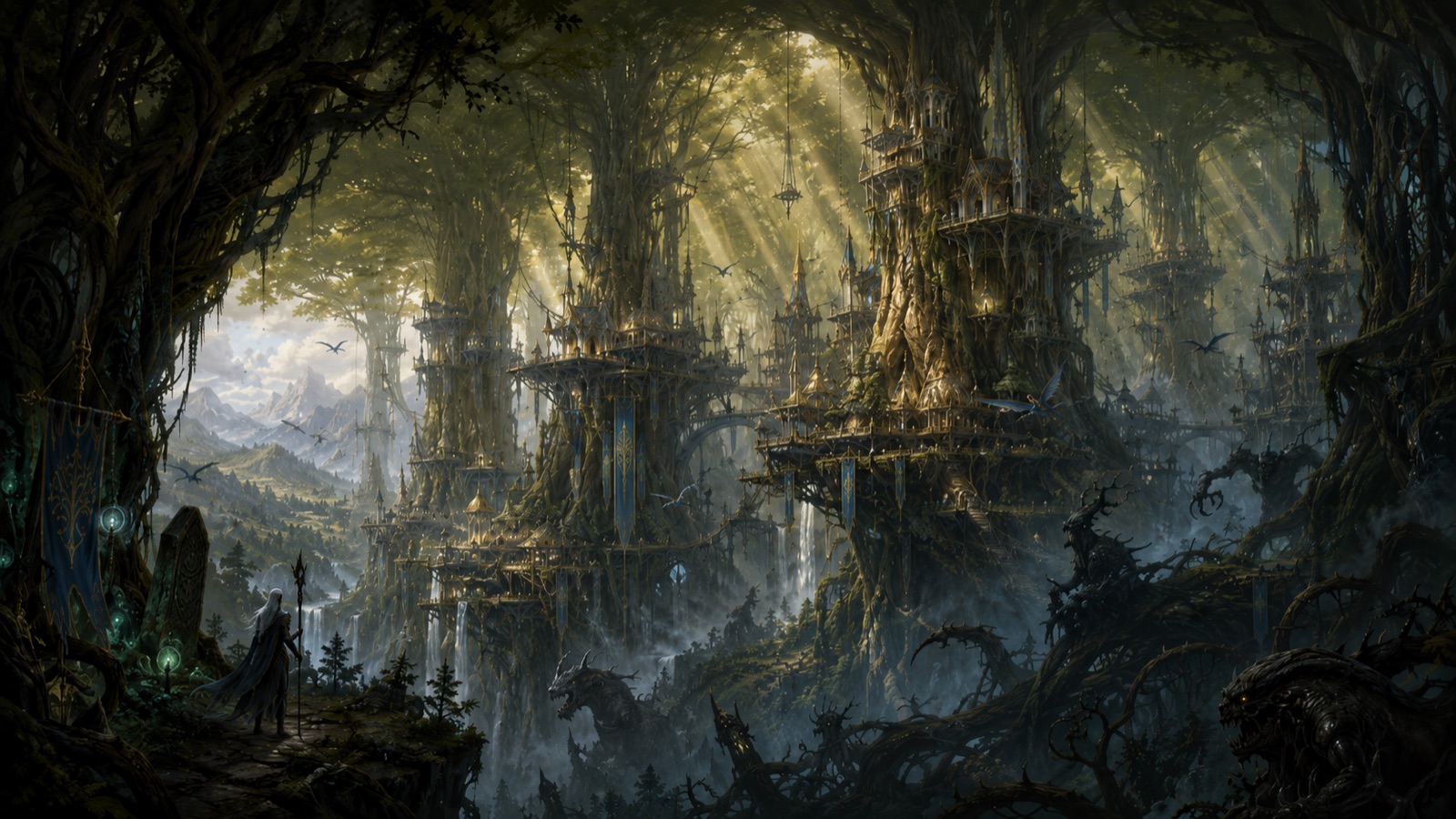
Aberdeen
Aberdeen is one of the great cities of the region: a wealthy harbor, a major production center, a fashionable cultural capital, and the seat of an entrenched magical hierarchy — a city where magical talent is measured, licensed, weaponized, and ruled. It is ruled by the leader of the dominant magical clan; for roughly a century that has been the Clan of Light, whose sage and leader Haladin is therefore the ruler of Aberdeen.
Geography
Aberdeen lies east of both Sunton and Tyre, at the mouth of the great Lor’sha’une River. Its harbor opens the city to extensive sea trade, while the river connects it to inland communities and routes associated with the Lor’Sha’Une forest. The city dominates the nearby valley economically and politically: farms, orchards, and ranches support its population, sheep above all, supplying food, wool, and raw material for its textile and carpet industries. To the south lies a mining and industrial region associated with coal, iron, and steel.
The large harbor is one of the foundations of the city’s power, bringing in foreign goods, dyes, travelers, sailors, rumors, and wealth while carrying finished products outward. The trade routes make Aberdeen cosmopolitan, but the openness of its markets does not extend to its political and magical institutions.
Economy and craft
Aberdeen is both a production hub and a trade hub, its wealth distributed among many small businesses, small shipping companies, independent craftspeople, workshops, and traders rather than a single monopoly. Major exports are cloth, clothing, woven carpets, porcelain, ceramics, jewelry, metalwork, and luxury goods. An unnamed local tree produces edible fruit and, when it flowers, a stringy substance that can be harvested and worked much like cotton; Aberdeen turns this fiber into cloth and exports both cloth and finished clothing. The city imports many dyes but cuts the cloth, sets the styles, and does not merely sell clothing — it helps define what is fashionable.
More than a thousand years ago Tyre was the great center of culture, trade, and crafting; when Tyre was abandoned, that role shifted to Aberdeen, which has held it for more than a millennium. Aberdeen’s craftspeople are among the most talented in the world, yet ancient works from Tyre suggest a level of skill modern artisans cannot fully match, leaving a persistent sense that the greatest techniques were lost. The city has many master craftspeople; grandmasters are rare and highly desirable; there are no known sage-level crafters. Artifacts, tools, manuals, patterns, and ingredients connected to Tyre are exceptionally valuable. Magical crafting, including arcane metalwork, depends heavily on dangerous harvested ingredients; Sunton’s Ranger Guild is an important supplier because Rangers can find, defeat, and harvest what ordinary tradespeople cannot safely approach.
Government
Aberdeen is ruled by its magical clans, not a royal family. An inter-clan tournament is held every other year; the clan of the most powerful victorious magic user becomes the ruling clan, and its leader the effective ruler of the city. The system was meant to keep the clans from destroying one another, but it makes raw magical power the foundation of political legitimacy. The Clan of Light has dominated for about one hundred years, turning what might have been rotating leadership into an entrenched regime. Aberdeen’s armies are the combined forces of the clans — soldiers, officers, specialists, enforcers, and magical defenders — so the military is an extension of the ruling institutions.
Nobles remain, tied to old families, land, wealth, political service, clan relationships, patronage, and marriage, but they form no separate monarchy. Merchants may grow extremely rich without gaining the authority of clan leaders or established noble families. The city’s deepest divide is not rich against poor but those admitted into the magical-political system against those outside it.
The eight clans and the nine magics
There are nine known forms of magic in the Land of Song; Aberdeen has eight clans, one for each form except Dize (lightning, imbuing, and life magic), an affinity so rare that no stable Dize clan has ever formed. The nine, by the existing magic notes: Uma (red — fire, emotion), Dize (silver — lightning, imbuing, life; no clan), Rez (sapphire — water, healing), Quet (orange — earth, physical enhancement), Uri (yellow — light, magical enhancement; the current ruling tradition), Breis (opal/pearl — wind, magical sense), Laven (purple — ice, illusion, psionic magic), Cufo (black — necrotic force, telekinesis, physical sense), and Nuhze (green — poison, plants, nature, shapeshifting).
Magical ability varies from person to person the way physical ability does; two people with the same broad affinity may wield it very differently. Entry to the clan system requires an official test revealing affinity, strength, control, and distinctive characteristics — and the testing fee is exorbitant, so many people with genuine talent are never recognized or trained. Clan membership brings training, spells, status, legal protection, opportunity, and the clan’s political network, in exchange for fees, service, obedience, and recognition of the clan’s authority. The clans guard their methods fiercely and treat unauthorized practitioners as thieves; enforcers may threaten, assault, financially ruin, or kill people who practice a clan’s magic without permission, refuse required fees, or withhold a share of magical earnings.
The inner city and the shared castle
The eight clan towers or keeps stand within the inner city — the center of government, magical training, military command, wealth, and elite residence. The central castle is not a monarch’s home but a vast shared manor for nobles, wealthy families, clan members, and the magical elite, funded collectively by the nobles and belonging to no single household. Final authority over it belongs to the leader of the ruling clan: Haladin controls room assignments, access, and major decisions. Each clan member has some right to a room or access; nobles and wealthy outsiders may buy their way in; the location and quality of one’s rooms reveal one’s standing. Generations of ruling clans altered the castle’s design, but a century of Light Clan dominance has kept its present arrangement unusually stable — a monument to prolonged Light Clan rule.
Haladin and the Clan of Light
Haladin is the sage and leader of the Clan of Light, the leader of the eight clans, and the ruler of Aberdeen: cold, cruel, calculating, and exacting toward his own clan, driven by greed, political ambition, and a desire to expand his control over the city and region. He is an extremely powerful magic user who knows high-level spells, many of which resemble effects of other traditions reshaped through light magic — a spell that would normally strike as lightning might manifest as a devastating ray of light dealing radiant damage. He is strongly prejudiced against those who do not know light magic, considers light magic superior, and aims not merely to stay first among the clans but to own, absorb, or completely dominate every other school of magic. Sunton and any independent magical school are ideological threats because they demonstrate that people can train, craft, organize, and defend themselves without clan ownership.
David is Haladin’s son. He seeks a path outside the Clan of Light’s expectations and has become connected to the Rangers; Haladin outwardly permits this.
People
- Govannon — master smith who once owned a respected arcane smithy near the Clan of Light keep; expelled from Aberdeen when he refused to make swords for the Clan of Light. Five apprentices followed him to Sunton, where he established another successful smithy. His son Haearn becomes one of the Rangers of Phoenix Roost.
- Iago — Govannon’s former apprentice, now the master Arcane Forger controlling Govannon’s old workshop near the Light Clan keep, with at least a dozen apprentices and journey workers. He cooperated with the Clan of Light to have Govannon removed, then took the land, smithy, equipment, and business. Genuinely skilled; whiny, conniving, somewhat weaselly in appearance, with frequent sneezing fits from a smithing attempt gone wrong. He strongly desires very rare and legendary ingredients to craft legendary items and become famous. Married to a noble’s daughter; their twin children attend the Clan of Light school.
- Teirtu — a minstrel by profession, though bard is not his class: mysterious, wild, cryptic, and exceptionally talented as a storyteller, musician, and performer. His tales and rumors spark quests; he reveals truths indirectly; people and their desires amuse him. Extremely loyal, though almost no one knows to whom or to what.
- Beef — owner of the Bull by the Thorns: five foot nothing and built like a twig, with a deep voice that sounds as though it has shouted commands through a thousand battles. All jokes and grins, yet a shrewd businessman who notices customers, opportunities, trouble, and valuable information.
- Rose — Beef’s wife: seven feet tall, red hair, hazel eyes, extremely beautiful; she looks more like a lady of court than the axe-wielding adventurer she once was. She and Beef belonged to the same adventuring company and fell in love traveling together; they are more willing than most in Aberdeen to stand against tyranny, but usually subtly enough to avoid retaliation.
- The Minotaur guard family — a family of no-nonsense Minotaurs who live on the premises of the Bull by the Thorns and serve as its bouncers and guards; at least two are always on duty to keep out the thugs, thieves, and thrifty.
Locations
The Bull by the Thorns is a very large public house, juice bar, and inn owned by Beef and Rose, with stable services and rooms from modest to wealthy rates. Adventurers, Rangers, ronin, errant knights, sea captains, merchants, and travelers frequent it, and talented entertainers are almost always visiting, making it a natural meeting place for rumors, contracts, quests, and chance encounters; the resident Minotaur family provides its security. Govannon’s former arcane smithy, near the Clan of Light keep and now run by Iago, is both production workshop and training center supplying the ruling clan. Each clan’s tower, keep, school, or fortified compound in the inner city is a center of education, administration, military organization, archives, spell knowledge, and clan identity.
Aberdeen and Sunton
Sunton was founded by people who rejected Aberdeen’s magical fees, clan control, taxation, elitism, and bullying — not necessarily magic itself, but the idea that the clans owned it. They settled islands in the river that were not clearly Aberdeen’s: anciently the river islands belonged to the Al’Tyr Aesir family, the most powerful of the Aesir families and the family from which the original Great Aesir came. The Al’Tyr have not been heard from for a very long time, but tradition and fear still discourage Aberdeen from formally seizing their territory; Sunton’s people are, technically, squatters on Al’Tyr land, and that uncertain status is also their protection. Sunton’s walls and ballistae declare that Aberdeen’s authority ends at the river. Despite the hostility, Aberdeen has become dependent on Sunton’s orchards, livestock, craftspeople, trade, and especially its Rangers’ magical harvests: distrust, resentment, and economic necessity together.
The open school of magic
Tyrus’s father plans a magical school open to everyone, with no exorbitant testing fee and no purchased clan entry required to learn one’s abilities. This threatens every point of clan control: poor families could discover talent without sponsorship, students could learn without lifelong debt, affinities could cooperate outside clan boundaries, graduates could practice without accepting the clans as magic’s owners, and the school’s success would prove the clans unnecessary. Haladin is likely to paint the school publicly as dangerous or irresponsible. Sunton proves a community can survive outside Aberdeen’s rule; the open school could prove magic can thrive outside the clans. (See Sunton for Tyr and Tyrus themselves.)