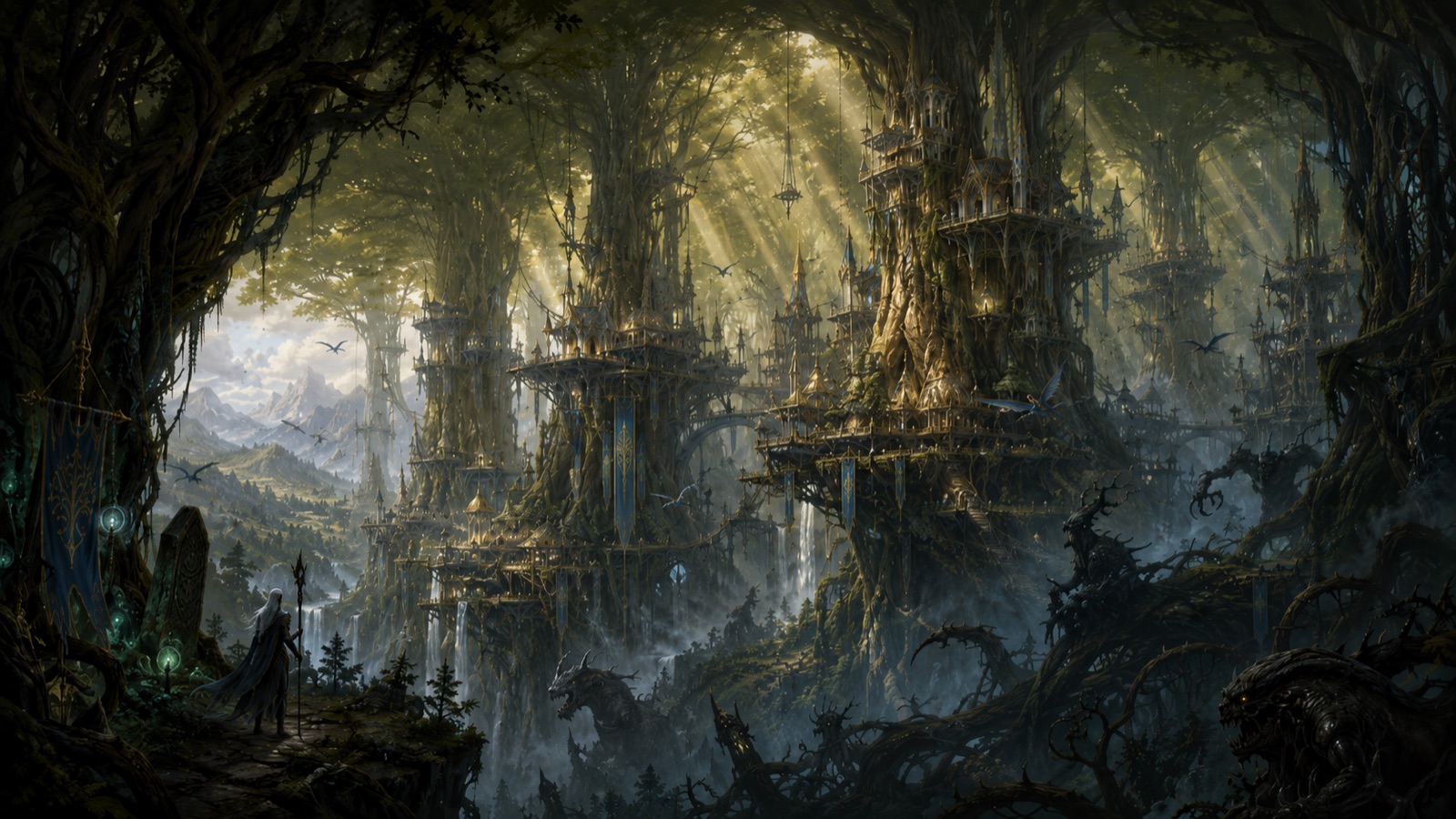
Tyre
Tyre is an ancient city on an island in the great Lor’sha’une River, in the settled east between the Lor’Sha’Une forest and the Saudient Mountains. It is cursed: by the stories, every mortal who has set foot on the island for hundreds if not thousands of years has disappeared and never been seen again.
An ancient bridge leads from the northern shore to the island, hundreds of feet above the water — untouched for centuries yet in perfect, pristine condition, broad enough that an army could march over it. A second bridge runs from Tyre’s island to the island of Sunton. No one in their right mind crosses either onto Tyre.
The party, shipwrecked in the crossing, washed up on the island of Tyre: verdant and sunlit, ringed by cliffs of some three hundred feet, with a trail winding up toward the walled city. What befell them there is told in session 1.
The walls and the customs of cargo
The city’s walls are black stone hung with ivy, the gate sealed. Outside stands a roofless customs shelter: a pedestal bearing a basin of hardened black beeswax and a bronze mouth, carved with travelers marking crates beside hulking figures. Its Celestial inscription reads: “That which cannot enter by its own authority must be declared. Mark the burden, name the burden, and trust the burden to Tyre” — ending in the word CARGO. Marks written in the wax in Common do nothing; marks in Celestial called rock golems up from the ground — eight in all — which carried each person over the wall like cargo, without malice, and set them down at the market.
Within the walls
The city has stood abandoned for about a thousand years, yet its main road is oddly intact. The buildings are dark gray and black stone, three and four stories, their roofs fallen in. Sheep thrive in the ruins. Shadows lie everywhere; flashes of color vanish when looked at; and unseen dogs pant in the streets — dogs that blink from place to place and multiply when struck. Three humanoid shadows also walk the city, allegiance unknown. In the ancient market courtyard a pillar of rainbow light some thirty feet across pours into the sky, and an ominous, resonating song meets those who approach it. West of the market rise the white towers of a castle untouched by ruin. On the market square stands the Moon and Phoenix, a shop found intact.
What the city was
Told by Tanwen in session 3, who was surprised the party did not already know it — though she allowed it may only be common knowledge where she comes from.
A thousand years ago Tyre was a seat of Aesir power: the seat of the great Aesir known as the Storm. It was a great city of trade and of learning, and a city of order and law.
When the Aesir and the Vaenir went to war, the Vaenir did everything they could to destroy it. They succeeded against the other great Aesir cities, one after another. Tyre is the only one that survived, because the Storm’s power was so great that nothing came close to threatening it.
Ewein recognised the arms and armour the party carried out of the Moon and Phoenix — the silver bird above the crescent — as the heraldic symbol of the Storm. The lucky coins the boy from the ferry handed out carry that same bird on one face, and a lightning bolt on the other.
The rainbow bridges
There were rainbow bridges everywhere once, and they did no one any harm.
Then something happened. The Storm grew angry, and made the bridges into what they now are: he drew the Vaenir into them, sealed them away, and exiled them across. Those great Vaenir have never been seen again.
The Storm had built at least one before that, and for mercy — a bridge to the moon, so that Luna might live in a world without magic. That story is told in Why the Wolf Cries to the Moon.
The pillar of rainbow light still standing in Tyre’s market square may therefore still be taking people across. Tanwen believes it took her son Rowen.
The Phoenix Roost, and the Great Library
From Tyleth’s map, drawn for the party in session 4: the market and the well where the rainbow pillar stands, the Moon and Phoenix, the roads — and at the far western end of the island a palace he named the Phoenix Roost.
He speaks of the city’s Great Library as the greatest that ever was: a repository holding a copy of most, if not all, of the knowledge in the world, and magical enough that he would not be surprised to find it still standing after a thousand years with not a page out of place. It has guardians — caretakers, and wards against thieves. He does not know what condition they are in, whether they still function, or whether they would prove an obstacle or a help.
The bridge that never shut
Tyleth’s account of the curse: Tyre’s rainbow bridge is simply one that was never closed after the war. Anyone who sets foot on the island unanchored is drawn toward the pillar, compelled, and taken across to the world on the far side, with no way back. That is what the town means by the Lost.
The trap runs one way. Anything already on the far side may cross back and forth freely — which is his best guess at what the walking shadows and the blink dogs are, most likely natives of the Fae world.
Anchoring passes by touch: an anchored person anchors anyone holding on to them, and one anchor will serve a hundred people so long as the chain of hands is never broken.
The pillar is also in the wrong place. It stands over the market well, and water keeps a bridge unstable; moved until its edge rests on land it would steady, and could then be repaired or shut. Something powerful on the far side may have moved it, trying to get out.