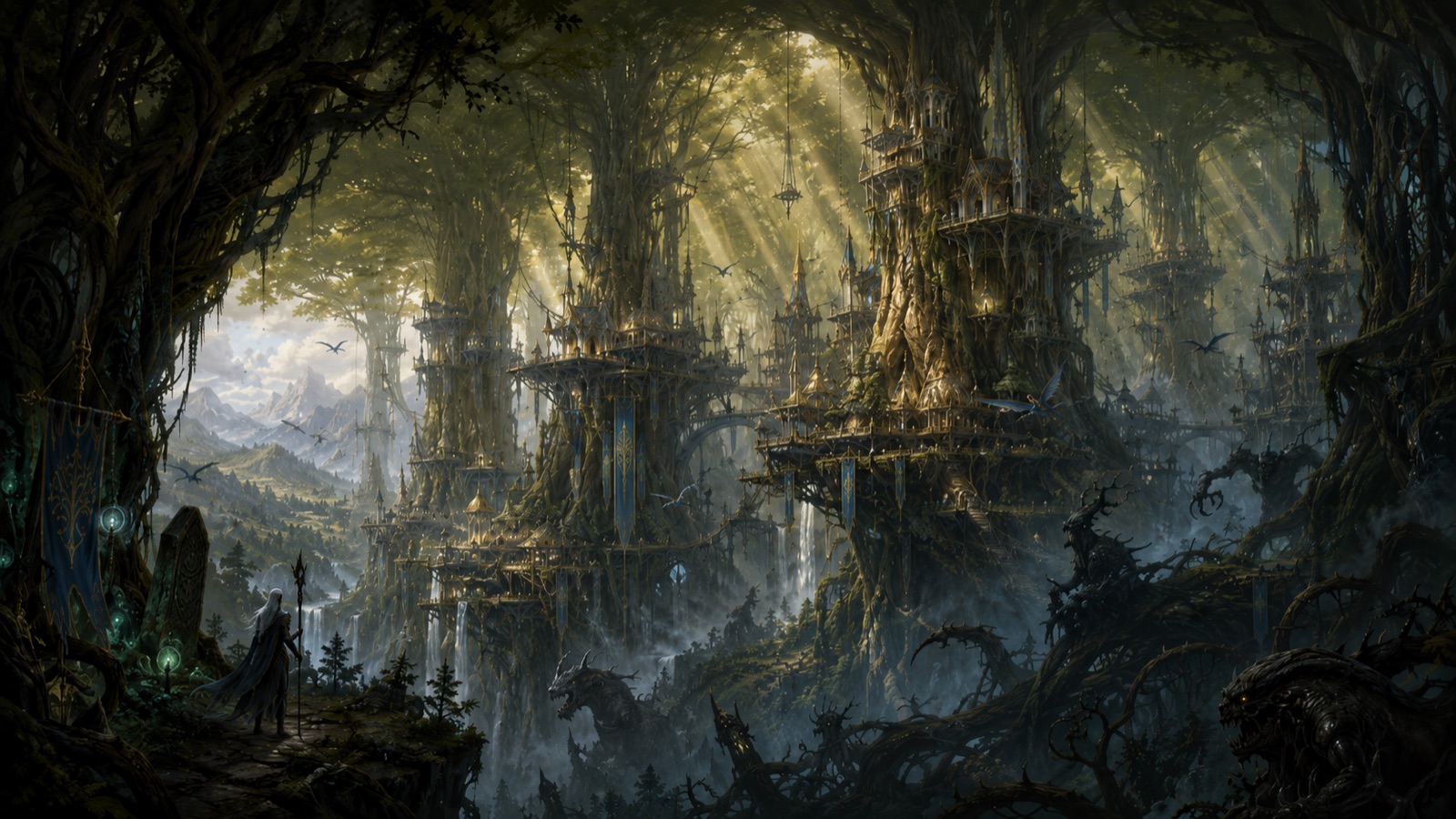
Tyleth
Tyleth is a historian, newly settled in Sunton — about three and a half months, by Govannon’s reckoning, who calls him a good man and says he seems to know a great deal.
He is tall, with silver eyes — not blue, not grey, not storm-grey — and white hair above a face whose skin has not aged with it. Across his back, within reach of his right hand, he carries three swords with black grips, their pommels set with a sapphire, a diamond, and a turquoise stone. The metal is more silvery than steel and is not silver, and nobody in the party recognised it.
He stopped the seven in the street on their first morning in Sunton, said he had heard of them, and asked them to find him at the Sunburst before they left the city. They did, in session 4, and found him at a table alone with a book. Niðrerir studied him and came away with the plain sense that whatever Tyleth says can be trusted.
What he told them of the bridges
Before the war, both Aesir and Vaenir knew that great magical beings could travel between worlds, and the rainbow bridges were how they went visiting — worlds beautiful, dangerous, and strange enough that only song describes them.
In the Great War the Aesir weaponised them. They learned to anchor themselves against the pull; the Vaenir never did. So the Aesir opened bridges the Vaenir could not resist, and the Vaenir were drawn in and exiled beyond them. That is how the war ended — and at its end most, if not all, of the Great Aesir vanished at the same moment. He knows no one who can say why. Some hold they spent themselves to shield the rest of the Aesir; others that they grew tired and went to begin again in some other world.
Tyre’s curse, he believes, is simply a bridge that never shut. Anyone stepping onto that island unanchored is drawn to the pillar and taken across, with no way home.
One anchor is enough for a hundred. Anything already on the far side can cross back and forth freely — the trap only runs one way. And a person who is anchored anchors everyone touching them, so long as the chain of hands is not broken. He would stake his life, and theirs, on it. This is what makes Rowen recoverable.
He also holds that the pillar in Tyre’s market is in the wrong place. It stands over the well, and water keeps a bridge chaotic; move it so its edge rests on land and it will steady, and can then be mended or closed. Something powerful on the far side may have moved it, trying to get out.
“That bridge was built for a reason, and that other side is not going to be a safe place. Be careful what follows you, or what you bring back.”
He guesses the walking shadows and the blink dogs are natives of the far side — probably the Fae world — and notes that blink dogs are extremely fond of sheep, which would explain Tyre’s flocks and their condition.
Minstrel magic
When Zureth described the dark certainty he felt near the pillar, Tyleth told him it was neither magic nor the bridge’s pull, but song — and that he may have the making of a minstrel.
The Al’Tyr
He identified the party’s looted heraldry as the symbol of the Al’Tyr, and drew them a map of Tyre marking the market and its well, the shop they sheltered in, the roads, and the palace on the island’s western end that he named the Phoenix Roost. He asked who the father of the Al’Tyr was, expecting to be answered, and was not.
He speaks of the Great Library of Tyre as the greatest that ever was — a copy of nearly all the knowledge in the world, and magical enough that he would not be surprised to find it intact with every page in place. It has guardians. He does not know their condition, or whether they would prove an obstacle or a help.
What he wants
To open a school of magic, free and open to all, and to open it in Tyre. He holds Aberdeen’s nine clans in contempt: possessive of magic and of magic users, charging exorbitant fees, and — by tales he credits — making people disappear over unpaid clan dues.
He intends to cross to Tyre himself eventually. Invited to come along now, he declined; he has work in the city first.
“Make sure that whatever decisions you’re making are wise. What’s right may not always be obvious, and it may not always be popular.”